Revit Training in Dehradun
Revit
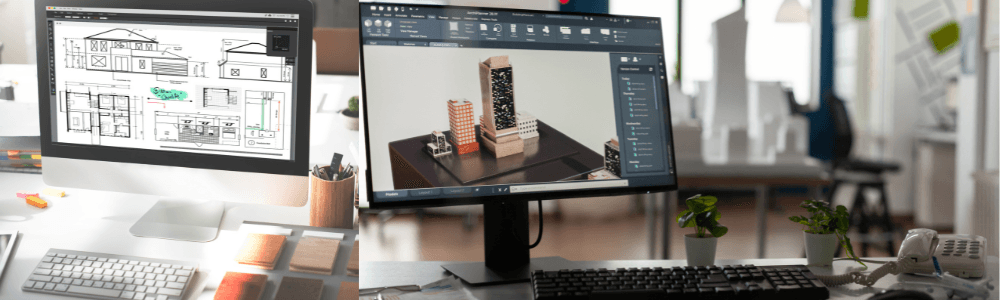
Revit is a Building Information Modeling (BIM) software developed by Autodesk. It is specifically designed for architects, engineers, construction professionals, and building owners to plan, design, construct, and manage buildings and infrastructure projects. Revit is widely used in the architecture, engineering, and construction (AEC) industry to create intelligent 3D models of buildings and their components. These models contain detailed information about the building’s physical and functional characteristics, making Revit a powerful tool for collaborative and data-rich design and construction processes.
Role of Revit
Building Design CAD tools make home design, redoing, interior design, and kitchen & bath design easy. Using Civil Engineering CAD courses is a simple way to design, estimate and manage structure systems. When combined with structure Information Modeling(BIM) features, Civil Engineering CAD tools help contrivers fantasize, pretend, and dissect their designs. Importantly, with CAD, it becomes easy to identify design excrescences and pinpoint serious figure problems.
Revit is a Building Information Modeling (BIM) software developed by Autodesk. It is specifically designed for architects, engineers, construction professionals, and building owners to plan, design, construct, and manage buildings and infrastructure projects. Revit is widely used in the architecture, engineering, and construction (AEC) industry to create intelligent 3D models of buildings and their components. These models contain detailed information about the building’s physical and functional characteristics, making Revit a powerful tool for collaborative and data-rich design and construction processes.
Key features and aspects of Revit include:
BIM Modeling: Revit enables users to create 3D digital models of buildings and infrastructure, including walls, floors, roofs, doors, windows, and structural components. These models are parametric, meaning that changes made to one part of the model automatically update related elements.
Intelligent Components: Revit models are composed of intelligent components with real-world properties and behaviors. This allows for accurate simulations, calculations, and analysis throughout the project lifecycle.
Collaboration: Revit facilitates collaboration among architects, engineers, contractors, and other stakeholders by providing a centralized platform for project data and documentation. Multiple team members can work on the same project simultaneously.
Integrated Design: It offers integrated design tools for architecture, structure, and MEP (Mechanical, Electrical, and Plumbing) systems, allowing multidisciplinary teams to work together seamlessly.
Design Visualization: Revit includes tools for creating realistic 3D visualizations, renderings, and walkthroughs, helping stakeholders visualize the final project before construction begins.
Analysis and Simulation: Users can perform structural analysis, energy analysis, and other simulations to optimize building performance, efficiency, and sustainability.
Documentation: Revit generates detailed construction documentation, including plans, sections, elevations, schedules, and material takeoffs, directly from the model. This ensures accuracy and consistency in project documentation.
Parametric Families: Revit allows the creation and customization of parametric families, which are reusable components that can be shared across projects, saving time and ensuring consistency.
Building Performance Analysis: It supports energy and environmental analysis to help designers make informed decisions about energy efficiency, daylighting, and thermal comfort.
Construction Management: Revit models can be used for construction management, clash detection, and coordination among various trades during the construction phase.
Facilities Management: Revit models continue to be valuable after construction for facilities management, maintenance, and renovations. They provide comprehensive data about building components and systems.
Interoperability: Revit can import and export files in various formats, allowing for collaboration with other design and analysis software.
Revit has become an industry standard for BIM in the AEC sector. Its ability to streamline workflows, improve project coordination, reduce errors, and enhance communication among project stakeholders has made it an essential tool for architects, engineers, contractors, and facility managers involved in building design and construction projects.
Introduction to BIM & Revit
Understanding BIM concepts Overview of the Revit interface Project setup and templates Navigation tools and basic settings
Architectural Modeling
Building 3D models Stairs, railings & ramps Rooms, spaces & room tags Curtain walls & partitions
Materials & Visualization
Applying materials & textures Lighting & camera setup Rendering techniques Walkthrough animations
Detailing & Documentation
Creating sections, elevations & callouts Annotations, tags, and dimensions Schedules & quantities Sheet creation & title blocks
Project Workflow
Complete building model creation Coordination & clash detection basics Preparing final project documentation Exporting and printing files
Revit Fundamentals
Working with levels & grids Understanding families & components Creating walls, floors, roofs, ceilings Placing doors and windows
Structural Modeling
Structural columns & beams Foundation, slabs & reinforcements Structural framing & analysis basics
MEP Basics
HVAC elements Electrical systems Plumbing components Coordination between MEP & architectural models
Worksharing & Collaboration
Linking CAD and Revit models Worksets & team collaboration Cloud collaboration (BIM 360 basics) Model management & best practices
Final Project & Certification
Hands-on real-world project Review & revision sessions Portfolio building Course completion certificate
Career Opportunities After Learning Revit

BIM Modeler / BIM Engineer
Revit Designer
Architectural Visualizer
Drafting Technician
3D Modeling Specialist
Construction Planning Professional
Contact Us
-
9d Astley Hall, Dehradun, Above Book World, Dehradun, Uttarakhand 248001
- Sudhowala Chowk, Dehradun, Uttarakhand, 248007
- +91 7351229999
- info@craftedu.in